Within the demanding arena of contemporary serious sliding, success is far more than exclusively a function of brute horsepower or behind-the-wheel bravado. Conversely, it has evolved into a multifaceted discipline which requires a scrupulous fusion of picking a proven chassis, arming it with the highest-quality competition components, and, most essentially, understanding its real-time characteristics on the circuit through cutting-edge vehicle dynamics analysis tools. This definitive guide acts as your master plan from the initial idea of a competition vehicle through to the last telemetry-optimized adjustments that transform a capable vehicle into a consistent podium finisher. We will examine in detail the art and science of vehicle alignment optimization, showing how a modern vehicle dynamics tool like precise measurement hardware eradicates guesswork and provides exceptional insight into your vehicle's real-world performance.
The foundation of any successful competitive sliding vehicle is, undoubtedly, the base vehicle itself. A select group of platforms have attained iconic status within the worldwide oversteer culture due to their inherent weight distribution, durable construction, and the vast range of aftermarket support available. Choosing the correct starting point is the initial and most important selection a enthusiast will make. As an example, the the E36 generation BMW is universally acknowledged as among the greatest all-around drift cars of all time. Its near-perfect balanced front-to-rear weight, coupled with a rear-wheel-drive setup and extremely reliable straight-six powerplants, establishes a car that is both easy to handle for novices and incredibly competitive in the hands of a pro pilot. The successor of this lineage, the E46 model BMW, refines these qualities with a increasingly sophisticated frame, increased wheel track for enhanced confidence, and still more turning capability directly from the factory. A distinct formidable option in the pro scene is the Corvette C6.
This V8-powered track weapon introduces a particular array of advantages to the sliding sport, such as a low-mass aluminum structure, a rear-mounted drivetrain component that contributes to an perfect weight distribution, and the colossal torque of a big LS V8 motor. This fusion makes it an utter force on track, capable of starting and sustaining long slides with relatively effortless use of acceleration. For those seeking outstanding performance per dollar, the Nissan 350Z rises above as a excellent candidate. It comes from the manufacturer with a robust chassis, a effective OEM locking differential, and the smooth VQ35DE powerplant that offers sufficient performance for practicing and progressing in the sport. Its successor, the 370Z model, presents additional improvements in body strength, suspension design, and peak powerplant performance, establishing its status as a common pick among professional pilots. Further historic vehicles that warrant attention are the nimble Wankel-engined FC generation RX-7, the ever-present S13 Silvia/240SX, the V8-powered SN95 generation Mustang, the modern BMW E90, and the small yet unbelievably playful and instructive MX-5 Miata. Every single one of these platforms provides a unique array of traits, challenges, and potentials, but they all possess the core elements necessary to serve as a capable drift machine.
However, choosing the right platform is only the first step. To unlock the complete capability of any of these machines, substantial modifications to the steering geometry and chassis control systems are completely non-negotiable. This is where the world of precision drift-spec parts comes into critical importance. The one most transformative modification for a dedicated competition vehicle is the fitting of a drift-spec steering angle kit. These sophisticated systems, such as those engineered by industry leaders like specialist manufacturers, are designed to dramatically increase the car's possible turning lock. A OEM street car is extremely constrained in how far its front wheels can pivot, a design trade-off for daily use. In sliding, conversely, extreme opposite lock is frequently required to control and sustain a angle. An angle kit substitutes the stock steering knuckles, rod ends, and often control arms with parts that permit the steered wheels to achieve degrees of turn beyond 70 or even 80 °, compared to a average stock limit of around 40 to 50 °.
This tremendously increased steering angle gives the pilot with significantly enhanced authority during a angle, making it much more straightforward to begin a slide, sustain it through a long corner, and transition smoothly from one direction to another. The contrast in controllability is absolutely transformative. Coupled with a correctly chosen steering kit is the just as essential modification to the vehicle's suspension. Off-the-shelf or even high-end street coilovers are generally not intended for the unique and extreme demands of sliding. A drift-spec system of adjustable dampers is of utmost importance. These engineered coilovers feature custom piston tuning and spring stiffness that are tuned for the extreme mass transition that is inherent of sliding. When a driver begins a slide, the chassis's weight is thrown forcefully to the front of the turn. Proper drift-spec dampers handle this movement in a predictable way, enabling the car to find its balance rapidly and providing the operator precise response through the wheel and seat. They also allow for exact tuning of ride height, rebound and compression rate, and cross-weight, which are all fundamental elements of fine-tuning the car's behavior to a particular circuit or driving technique. Together, a top-tier angle modification system and a properly selected system of drift-spec adjustable dampers are the absolute hardware cornerstone upon which all future optimization is constructed.
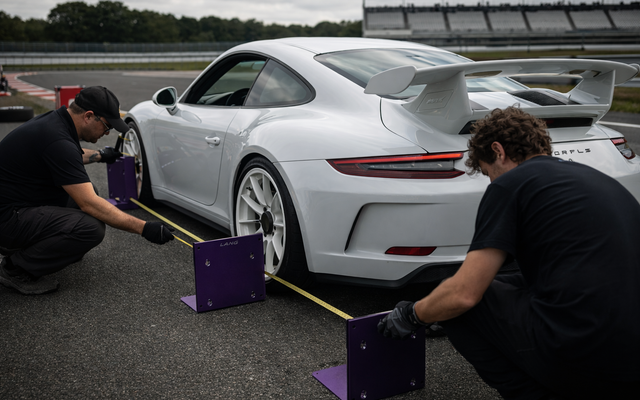
Once the essential parts is in place, the subsequent essential step in the development is the detailed setting of the vehicle's suspension geometry. This is the world of car suspension tuning, a procedure that can appear intimidating to the uninitiated but is, in fact, the key to transforming a collection of high-performance pieces into a cohesive and consistent vehicle. The most critical parameter of alignment for drifting is certainly camber angle. Camber angle is the inclination of the rim compared to the vertical axis when viewed from the front of the vehicle. When the top of the wheel is tilted inward, this is known as negative camber. For drifting, inward-leaning wheels on the front wheels is universally suspension engineering used and is regarded as necessary. The logic is deeply linked to physics.
When a car is going around a bend at high slip angles, the body rolls towards the outer of the bend. This lean forces the outer steering tire to reduce its ideal contact patch with the tarmac. By applying inward lean, the wheel is pre-angled to compensate for this roll. As the chassis tilts into the bend, the tire becomes more upright against the road surface, optimizing its traction at the precise point when it is absolutely essential for steering authority. Typically, front axle angles for a dedicated drift car fall between approximately -3 degrees to as extreme as -5 degrees or even beyond, contingent on the specifics of the vehicle configuration, tire type, and driver style. The rear wheels also employ inward tilt, but the settings are typically less and less aggressive than the front. Overly aggressive inward lean at the back can cause the vehicle to extremely tail-happy and hard to manage on acceleration application, as it shrinks the effective grip area of the driving wheels during linear power delivery. Therefore, rear axle adjustments are frequently in the vicinity of -1 degree to -3 degrees, striking a careful equilibrium between providing sufficient lateral grip to assist in entering and holding the slide while simultaneously preserving good hook-up for power-down the turn. alignment is just one element of the broader tuning equation, which furthermore includes toe angle, self-centering steering, and bump steer correction.
Toe angle describes the orientation of the tires when viewed from above. Inward toe means the leading edges of the tires are nearer together than the trailing edges, while negative toe means the opposite. For drifting, a small amount of front toe out is frequently employed to quicken the initial response directional response, making the car feel more agile and eager to start a drift. Rear axle toe angle is generally set to neutral or a incredibly slight amount of toe-in to foster stability under acceleration. Caster is the forward or aft inclination of the suspension pivot when observed from the lateral of the chassis. More caster angle improves feedback and high-velocity confidence, and it also increases negative camber effect during steering, which is very advantageous. Adjusting these parameters is a detailed dance where a adjustment to one parameter can and often will influence the remaining parameters. The conventional method for dialing in a car's suspension geometry for competition has for a long time been a time-consuming process of trial and error. A driver or engineering group would apply a change based on a hunch, test the car on track, depend on the pilot's individual sensation and feedback, and then introduce a further adjustment. This loop would repeat time after time until the vehicle felt "acceptable" or the allotted track session ran out. This approach is not only extremely inefficient in terms of time and costs, but it is additionally deeply inaccurate.
Pilot perception is a famously unreliable measurement tool, influenced by numerous factors such as tiredness, evolving track conditions, ambient heat, and simply the mindset of the operator on that particular session. What feels "tail-happy" on one lap might feel "understeery" on the subsequent lap, resulting in contradictory feedback and ineffective tweaks. This age-old problem in chassis setup is precisely where contemporary telemetry systems has stepped in to completely change the landscape.
The development and integration of sophisticated suspension tuning applications has ushered in a new age for engineering and perfecting professional drift cars. These systems, represented by groundbreaking solutions like data acquisition tools, work by actively recording the actual dynamic performance of the vehicle as it is being driven on the track. Unlike relying on subjective feedback, these devices acquire measurable metrics on essential factors such as suspension travel, wheel speed, lateral and longitudinal g-forces, steering angle, and throttle and brake application. This acquired telemetry is then interpreted by advanced algorithms that can visualize and interpret the metrics in a actionable way. For the very first time, tuners and builders can visualize precisely what the car is exhibiting at each moment of a drift. This function revolutionizes the whole suspension tuning workflow. Think about the particular goal of setting the front negative camber for a specific car. As an alternative to applying a change from -3 degrees to -3.5 degrees and then running several laps to try and "perceive" a change, a vehicle dynamics tool can deliver immediate and clear feedback. The software can indicate visually how the wheel's contact patch is performing during the critical stages of a drift: the initial flick, sustain, and transition. It can reveal if the existing camber setting is allowing the loaded tire to achieve maximum loading or if the rubber is overloaded on its outer edge.
The system can after analysis suggest fact-based suggestions for adjustment. Perhaps the information shows that the outside front tire is still overloading its edge at -3.5 degrees of camber, implying that an increase to angle, say -4 degrees, might be advantageous. Alternatively, the data might reveal that the tire is not achieving temperature or that the inner shoulder is wearing unevenly, which could suggest that there is excessive angle and a modest decrease back to -3.2 degrees would be more optimal. This degree of granularity and actionable intelligence was literally impossible in the time of exclusively mechanical tuning.
The effect of using a advanced drift telemetry system extends far beyond merely optimizing alignment. It becomes an invaluable suspension tuning guide that is specific to your exact car. When fine-tuning the damping clickers on your coilovers, instead of depending on general guidelines or copying another car's numbers, you can utilize the telemetry to analyze how the chassis is performing in reaction to your changes. The tool can show the damper movement path over a run, revealing if the dampers are handling the weight transfer optimally or if they are causing the car to oscillate excessively after a transition. It can help in diagnosing problems like excessive compression or excessive extension, enabling you to apply informed decisions to preload settings, damping rates, or ground clearance. This methodology applies similarly to the detailed process of corner drift angle kits balancing. Beyond camber, the software can provide analysis into how modifications to toe settings and caster angle are impacting the vehicle's stability during specific phases of a drift. For example, it can help you to determine the optimal amount of front negative toe for your particular steering rack setup and piloting approach by showing the response time of turn-in reaction and the consistency of the chassis at lock lock. This turns the software an extremely powerful vehicle dynamics manual that is constantly informed by the actual dynamics of your specific vehicle on the track. It shifts the complete endeavor from a subjective skill into a repeatable development procedure.
Moreover, the value of a tool like modern telemetry is not limited to professional tuners with extensive budgets. For the amateur driver, it functions as an amazing equalizer. It practically offers the tuner with the insight of a full-time dynamics engineer without requiring the corresponding overhead. It accelerates the learning curve by delivering clear solutions to questions that would otherwise take years of experimentation to answer. A builder can see how their specific vehicle behaves to different inputs, developing a deeper knowledge of car control in the journey. It furthermore democratizes advanced performance tuning concepts, enabling all drivers with the ambition to perfect their machine to do so in a structured and effective manner. This is especially significant in a activity like oversteer competition, where setup knowledge has traditionally been a highly secretive commodity among elite drivers. Today, that capability can be in the hands of any dedicated enthusiast.
In summary, the process to constructing and optimizing the ideal competitive sliding vehicle is a comprehensive mission that perfectly blends time-honored mechanical knowledge with revolutionary digital solutions. It starts with the strategic pick of a capable car, then built upon the installation of critical drift-spec hardware like high-performance drift angle kits and properly selected competition coilovers. The build then progresses into the detailed realm of car suspension engineering suspension tuning, where parameters like negative camber, toe setting, and caster are meticulously configured to complement the car's modified geometry and the pilot's specific technique. Ultimately, and what truly differentiates the contemporary methodology from the traditional methods, is the adoption of a sophisticated drift telemetry software. This platform removes the guesswork and inefficiency of solely subjective adjustment by providing empirical, actual information on how the car is really behaving. It functions as an incredible suspension tuning tool, a definitive alignment optimization handbook, and a master chassis development system. Together, this holistic approach guarantees that all element of the competition vehicle—from the selection of the car to the final click on the coilover—is perfected for maximum performance on the circuit. It represents the complete maturation of the discipline of oversteer driving, bridging raw driving skill with precise chassis dynamics to forge the perfect competitive cars imaginable.